


Views: 0 Author: Site Editor Publish Time: 2026-10-20 Origin: Site


In the high-stakes world of modern infrastructure development, subterranean environments present severe logistical hurdles. One persistent bottleneck stands out on almost every job site. There is a constant spatial clash between tunnel excavation, mucking, and invert concrete pouring. The invert forms the foundational floor of the tunnel. It requires strict curing conditions and a completely isolated workspace. But isolating the tunnel floor traditionally means halting all heavy traffic to the excavation face. This brings multi-million-dollar projects to a costly standstill.
Historically, engineering teams relied on stationary steel trestles to bridge the gap over the invert pouring area. While functional, these static structures demand frequent dismantling, relocation, and reassembly. This repetitive cycle causes massive delays. It requires the deployment of heavy portal cranes in confined underground spaces and introduces significant safety risks to the construction crew.
To resolve this critical bottleneck, the industry has shifted toward a dynamic engineering solution. Procuring a Self-Propelled Invert Trestle serves as the ultimate mobile overpass within the tunnel. It bridges the active invert construction zone. Heavy-duty mucking trucks and excavation equipment maintain continuous traffic flow above, while the concrete cures undisturbed below. This comprehensive guide explores the mechanics of this specialized equipment, its core performance advantages, technical specifications, and the empirical reasons why it has become an indispensable asset for high-speed railway and highway tunnel projects worldwide.
Uninterrupted Workflow: By acting as a heavy-duty overpass, these structures allow simultaneous excavation, mucking, and invert concrete pouring. This drastically reduces overall project timelines.
Automated Mobility: Built-in hydraulic and motorized propulsion systems eliminate the need for external cranes or heavy lifting equipment to move the bridge forward.
Enhanced Safety: The automated relocation process reduces manual labor, minimizes crane usage in hazardous spaces, and provides a highly stable platform for heavy machinery transit.
High Return on Investment: Despite the initial capital expenditure, the cumulative hours saved per meter of tunnel construction lead to significant reductions in long-term labor and operational costs.
Versatile Application: Structural dimensions and load capacities are highly customizable. They suit wide-span highway tunnels and highly constrained high-speed railway mountain tunnels alike.
A self-propelled invert trestle is a specialized mobile temporary steel bridge deployed exclusively in tunnel construction environments. Its primary function is to span the section of the tunnel where the bottom arc of the tunnel lining is currently being excavated, reinforced with steel rebar, or filled with curing concrete. By providing a suspended roadway, it ensures the logistical supply chain to the tunnel face remains unbroken.
The engineering reliability of these structures relies on the seamless integration of robust mechanical, structural, and hydraulic systems. To withstand extreme dynamic loads from 50-ton dump trucks, the framework must be meticulously crafted.
The main bridge frame is constructed from high-yield structural steel, typically Q345 or Q355 grade. This specific material choice resists severe bending moments and asymmetrical loads. Beneath this frame lies the hydraulic walking and propulsion system. This is the defining feature of the equipment. It consists of heavy-duty hydraulic cylinders for vertical lifting and motorized mechanisms for horizontal movement. Furthermore, the trestle is equipped with adjustable front and rear approach ramps. These facilitate the smooth transition of tracked and wheeled vehicles onto the bridge deck. Adjustable vertical support columns bear the immense load of the bridge. They transfer weight securely to stable sections of the tunnel floor, ensuring structural integrity even on jagged terrain.
To fully grasp the operational upgrade provided by mobile trestles, we must contrast them directly against traditional stationary models. In the past, relocating a temporary bridge required an entire shift of grueling manual labor. Workers dismantled the deck, brought in heavy portal cranes, lifted the steel components, and carefully re-leveled the structure further down the tunnel.
In stark contrast, the self-propelled variant operates via push-button automation. Utilizing its integrated hydraulic system, the bridge lifts itself off its supports, rolls forward on motorized tracks, and lowers itself into the next position. This transition requires minimal human intervention.
Feature | Traditional Stationary Trestle | Self-Propelled Invert Trestle |
|---|---|---|
Relocation Time | 4 to 8 hours | 15 to 30 minutes |
Crane Requirement | Heavy portal cranes mandatory | None required |
Labor Intensity | High dedicated rigging crew needed | Low single operator |
Safety Risks | Pinch points, crane rigging failures | Minimal automated movement |
Looking at recent global civil engineering data, there is a massive shift toward accelerated project delivery. Tighter government budgets and stricter environmental regulations demand faster completion rates. Consequently, modern tunnel contractors face severe penalty clauses for delayed infrastructure projects. The industry is moving rapidly away from sequential excavation. Automated temporary bridging is no longer just a convenience. It is rapidly becoming a mandatory requirement in competitive bidding for major highway and rail contracts. Relying on static structures is simply no longer viable for top-tier contractors aiming to maintain high daily advance rates.
To understand the necessity of this equipment, one must look at the structural mechanics of a tunnel itself. The invert is the curved foundational base of the cross-section. In modern tunneling methodologies, closing the structural ring quickly is paramount. The invert connects the two side walls, distributing the immense geological stress from the surrounding rock mass and preventing tunnel deformation. Because the invert must be excavated and poured seamlessly, it occupies the exact physical space required by transport vehicles.
Railway tunnels, particularly those designed for high-speed rail networks, present severe spatial constraints. They generally feature narrower cross-sections compared to their highway counterparts. Moreover, high-speed rail infrastructure demands incredibly strict tolerances for settlement. Even millimeter-level deviations in the invert can lead to catastrophic track misalignment. The confined space means that if an invert is being poured, there is absolutely no room for a transport truck to bypass the work zone. Implementing automated bridging solves this geometric limitation.
Highway tunnels operate on a vastly different scale. They require much wider structural spans to accommodate multiple traffic lanes. Consequently, the mucking trucks used in these excavations are significantly larger. They often carry up to 50 tons of rock per trip. The sheer volume of excavated material requires a high-frequency cycle of dump trucks entering and exiting the site. A highly durable, wide-span bridge is the only way to sustain this heavy logistical flow.
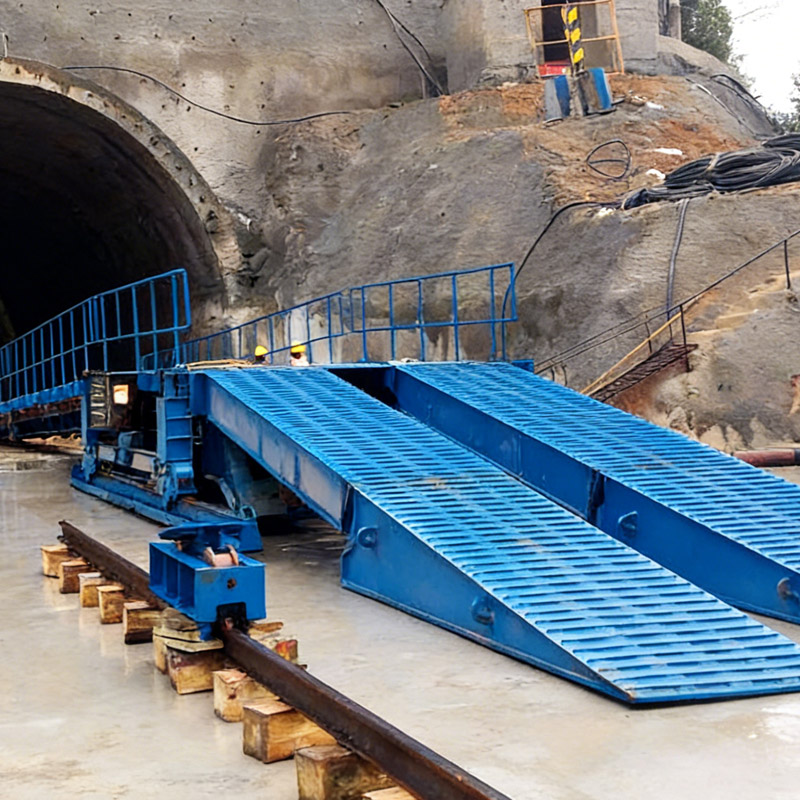
The primary justification for procuring this equipment is the measurable acceleration of the construction schedule. By optimizing the logistical flow deep underground, contractors achieve a significantly higher daily advance rate.
In traditional sequential tunneling, the workflow is strictly linear. Crews excavate, muck, halt traffic, pour the invert, wait for curing, and then resume traffic. This linear approach results in hours of idle time for the excavation crew at the tunnel face.
The automated trestle transforms this into a parallel operation model. By acting as a robust overpass, it segregates the workspace vertically. Mucking trucks and supply vehicles rumble continuously over the steel deck. Simultaneously, the concrete crew works safely underneath. They excavate the trench, lay rebar, and pour concrete. Because the concrete is shielded from vibrations and direct traffic, it cures to its optimal strength without interrupting the excavation cycle.
The most profound time-saving feature is the relocation process itself. In a standard project, the invert is poured in sections ranging from 6 to 12 meters in length. Once a section is cured, the temporary bridge must advance.
The self-moving aspect is powered by a sophisticated hydraulic walking system. The operator engages the hydraulic cylinders to lift the main bridge deck slightly. The motorized propulsion units then drive the structure forward to the next station at a controlled speed. Once in position, the hydraulic legs lower the bridge back down, anchoring it securely. This entire automated sequence takes mere minutes. Integrating a Self-Propelled Invert Trestle into the workflow shaves hours off every single pour cycle. This compounds into weeks of saved time over a multi-kilometer tunnel.
Space is the most valuable commodity inside a mountain tunnel. Deploying portal cranes or heavy excavators solely for the purpose of moving a temporary bridge creates severe logistical traffic jams. It forces other essential equipment to wait outside the portal or pull into narrow passing bays.
Because the self-propelled model manages its own mobility, it entirely removes the need for external lifting equipment in the invert zone. This reduction in machinery clutter allows for a cleaner, more organized worksite. It frees up the project's cranes to generate actual value at the excavation face.
Procurement officers and project managers must evaluate equipment based on tangible performance metrics. The advantages of these automated systems extend far beyond mere convenience. They directly impact the financial and safety parameters of the project.
Tunnel construction involves some of the heaviest machinery in civil engineering. These trestles are rigorously engineered to support extreme dynamic loads. A standard model is typically rated to support anywhere from 50 to over 100 tons. This capacity safely accommodates fully loaded mucking trucks, large concrete transit mixers, and heavy excavators simultaneously. The structural bracing absorbs the kinetic energy of moving vehicles. It prevents that energy from transferring to the fragile curing concrete below.
Labor efficiency is a critical factor in modern infrastructure. Traditional static bridges require dedicated rigging crews, crane operators, and assembly workers. The self-propelled model reduces this labor requirement drastically. A single trained operator, sometimes accompanied by a spotter, manages the entire relocation process using an electrical control panel. Project managers can then reallocate skilled labor from temporary bridge management to permanent structural tasks.
Underground construction environments are inherently hazardous. Manual assembly and disassembly of heavy steel components introduce risks of pinch-point injuries, crane rigging failures, and tripping hazards. Automated movement removes workers from the physical lifting process. Specifically, the robust guardrails and anti-slip decking of the trestle provide a secure standardized pathway for vehicles and pedestrians. This significantly reduces the likelihood of workplace accidents.
Selecting the right equipment requires analyzing specific technical specifications. Not all trestles are built to the same standards. Matching the equipment to the geological demands of the tunnel is paramount. When finalizing your equipment list, choosing a reliable tunnel invert trestle ensures these specifications are met with industrial-grade precision.
Customizable Span Lengths and Widths: Tunnel dimensions dictate the required size of the trestle. A single-track mountain railway tunnel may only require a narrow bridge with a shorter span. Conversely, a three-lane highway tunnel requires a wide heavy-duty structure to allow two-way truck traffic. Buyers must ensure the manufacturer offers fully customizable span lengths, typically ranging from 12 to 24 meters, to match the exact cross-section of their specific project.
Advanced Control Systems: The reliability of the equipment hinges entirely on its control systems. Buyers should look for systems equipped with Programmable Logic Controllers that offer precise synchronization of the hydraulic lifting cylinders. Because tunnels are damp and dusty environments, all electrical control panels and hydraulic power units must feature high Ingress Protection ratings. IP65 weather-proof and dust-proof enclosures are non-negotiable for underground longevity.
Material Quality and Anti-Corrosion Properties: The environment inside a mountain tunnel is highly corrosive due to groundwater seepage, high humidity, and acidic vehicle exhaust. The main structural framework must be fabricated from high-grade structural steel. Additionally, buyers must verify the anti-corrosion treatments applied to the steel. Industrial-grade epoxy coatings, hot-dip galvanizing on smaller components, and rust-inhibiting primers are essential features that extend the lifespan of the equipment across multiple multi-year projects.
Theoretical advantages must translate into practical field results. The deployment of these automated systems has become standard practice in major global infrastructure initiatives.
Consider a standard high-speed rail project traversing mountainous terrain. In a recent large-scale Asian high-speed rail deployment, contractors faced strict deadlines to complete a 10-kilometer mountain tunnel before the winter freeze. By implementing a self-propelled invert trestle, the engineering team maintained a continuous cycle of blasting, mucking, and invert pouring. The automated relocation saved approximately 3 hours per 12-meter pour cycle. This allowed the team to meet the strict track-laying schedule without compromising structural integrity.
In a recent European highway expansion project, a dual-tube multi-lane tunnel required rapid excavation through volatile rock formations. The sheer volume of excavated material demanded a constant stream of 40-ton dump trucks. A wide-span automatic trestle was deployed to handle the load. Its superior load-bearing capacity allowed two massive trucks to pass each other on the bridge simultaneously while the invert was poured below. This prevented any logistical bottlenecks at the tunnel face.
Procurement officers must justify the capital expenditure of automated equipment compared to traditional cheaper alternatives. An objective cost-benefit analysis reveals that the true value lies in operational efficiency.
It is an objective fact that self-propelled models carry a higher initial capital expenditure than static steel bridges. The integration of hydraulic pumps, motorized wheels, and control systems increases manufacturing costs. However, the return on investment is realized rapidly through operational expenditure savings. By eliminating crane rental costs and reducing the labor hours required for bridge relocation, the equipment amortizes its initial cost well before the tunnel is completed.
To understand the financial impact, one must calculate the time saved per operational cycle. Traditional rigging and relocation can easily consume 4 to 5 hours of a shift. In contrast, an automated system completes this sequence in under 45 minutes. Saving roughly 4 hours per invert pour cycle has a compounding effect. Over a 5-kilometer tunnel requiring hundreds of pour cycles, this equates to weeks or even months of saved time. In heavy civil engineering, a reduction in the project timeline translates directly into massive capital savings.
The self-propelled invert trestle is far more than a convenient piece of temporary scaffolding. It is a strategic engineering asset that transforms tunnel construction from a disjointed stop-and-go process into a continuous flowing operation. By enabling parallel workflows, automating the relocation process, and removing the need for heavy lifting equipment in confined spaces, contractors drastically improve their daily advance rates.
For modern railway and highway projects characterized by tight deadlines and strict structural tolerances, adopting this automated technology is essential for staying on schedule and on budget. For contractors ready to optimize their underground logistics, exploring customized solutions from JC Formwork provides access to industry-leading equipment tailored to exact load requirements and tunnel dimensions.
These structures are highly robust, typically designed to support anywhere from 50 to over 100 tons. This capacity easily accommodates fully loaded mucking trucks, large excavators, and concrete transit mixers simultaneously. The exact weight capacity is customizable based on the specific needs of the project.
Yes. Many modern self-propelled invert trestles feature adjustable hydraulic steering mechanisms and flexible joint designs. These allow them to smoothly navigate the gradual curves and gradients typical of highway and railway mountain tunnels.
Thanks to its automated hydraulic walking system, repositioning usually takes only 15 to 30 minutes. This is a massive improvement over traditional stationary trestles, which can require anywhere from 4 to 8 hours to manually dismantle, move, and reassemble.
They are highly customizable engineering solutions. Manufacturers can design the span length from 12 to 24 meters and adjust the deck width to fit everything from narrow utility and single-track railway tunnels to massive multi-lane highway tunnels.
Yes, but the operation is straightforward and highly labor-efficient. A single trained worker can operate the hydraulic lifting and electrical propulsion controls via a remote or onboard panel, entirely eliminating the need for large rigging crews and crane operators.
The system is typically powered by an onboard electro-hydraulic power unit. This unit connects to the tunnel's temporary power grid. It drives the hydraulic cylinders for vertical lifting and the heavy-duty motors required for horizontal track movement, ensuring smooth and controlled progression.
Maintenance focuses primarily on the hydraulic and electrical systems. Routine checks include inspecting hydraulic hoses for leaks, verifying hydraulic fluid levels, lubricating moving joints and tracks, and ensuring the IP65 electrical enclosures remain sealed against tunnel dust and moisture. The main steel framework requires periodic visual inspections for structural fatigue or coating wear.


